Gaming Is My DNA: What That Really Means and How to Wear It Without Looking Like a Beginner
You have seen the phrase everywhere. Gaming is My DNA pops up on t-shirts, hoodies, mugs, and profile pictures. It sounds bold. It feels personal. But when you decide to put it on a shirt you actually wear in public, the stakes change. Suddenly you are not just declaring a hobby—you are making a visual statement about who you are. And that statement can go wrong in ways most people never consider until they are staring at a poorly printed, pixelated mess that shrinks two sizes after one wash.
This is not about gatekeeping. This is about helping you avoid the quiet disappointment of spending money on a design that looks nothing like what you imagined. Whether you are a streamer building a brand, a small business owner selling merch, or just someone who wants a clean, comfortable shirt for game night, the quality of the files you start with matters more than you think.
The Difference Between a File That Works and One That Wastes Your Time
Most people shop for t-shirt designs the way they shop for wallpapers. They look at a preview image, think it looks cool, and hit download. That approach works fine for phone backgrounds. For apparel, it leads straight to disappointment. A Gaming is My DNA design needs to hold its sharpness whether you are printing it on a small chest logo or blowing it up across the entire back of a hoodie. If the source file is a low-resolution raster image, you will see jagged edges, blurring, or that dreaded white halo around the text.
This is where the file format list actually tells you what you need to know. Look for terms like 300 dpi, vector, and 4500×5400 px. These are not just technical jargon to ignore. A 300 dpi PNG at 4500×5400 pixels means the image carries enough data to print crisply at roughly 15 by 18 inches without degradation. An SVG or AI file means the design is vector-based, so you can scale it to the size of a billboard and the edges stay perfectly smooth. When someone delivers both raster and vector formats in one organized package, you are not just getting a picture—you are getting production-ready assets that work across screen printing, direct-to-garment, embroidery digitizing, and even promotional materials like posters or thumbnails.
The Mistake Almost Everyone Makes When Choosing a T-Shirt Design
The biggest error is judging a design by its mockup. A mockup is a digital preview showing the design on a virtual t-shirt model. It can look stunning because the mockup itself is a high-quality photograph with the graphic smartly placed on it. The actual design file might be a fraction of that resolution. You only discover the truth when your printer rejects the file or—worse—when you pick up your order and the print looks fuzzy compared to the shirt next to it in the store.
To avoid this, always check what is actually included in the download. A trustworthy bundle clearly lists the file formats and their specifications. You want to see at least one vector format such as SVG, AI, or EPS. These formats define the design using mathematical paths rather than fixed pixels. That means no quality loss at any size. The inclusion of PNG at 300 dpi gives you a ready-to-use raster version with transparency, which is convenient for quick uploads to print-on-demand platforms or for sharing with clients who do not own vector editing software.
Why Color Versions Matter More Than You Expect
Another overlooked detail involves color options. A design that looks incredible in full color on a black shirt might disappear entirely on a navy blue shirt. Designers often provide black, white, and color versions for exactly this reason. The white version uses inverted colors or outlines so the text remains visible against dark backgrounds. The black version works on light garments. The color version pops on neutral tones. If you only receive one color variant, you are limiting which shirt colors you can actually use.
This becomes even more critical if you are selling merchandise. Customers will want different shirt colors. If your Gaming is My DNA design only works on white shirts, you have just cut your potential sales by a significant margin. Having all three versions ready means you can upload multiple listings or offer variations without scrambling to edit files you do not have the skills to modify properly.
The Organization Trap That Costs You Hours
Downloading a zip file only to find fifty unnamed files labeled "final_version_2_edited" is a special kind of frustration. Good file organization saves you real time. When someone says you will get files well organized, that should mean clearly labeled folders separating vector files from raster files, color variants from each other, and perhaps even including a preview or font information. Disorganization leads to mistakes—like accidentally sending a low-resolution preview file to your printer instead of the high-quality production file.
Before committing to any purchase or download, ask yourself whether the file structure makes sense at a glance. A professional package groups things logically. It respects your time and your workflow. If you are a freelancer or a small business owner juggling multiple projects, that organization is not a luxury. It is a necessity that prevents embarrassing errors.
Understanding Vector vs. Raster Without the Jargon Overload
You do not need a design degree to understand this, but you do need enough knowledge to protect your results. A vector design uses lines and curves defined by coordinates. Zoom in as far as you want—the line stays crisp. A raster image uses a fixed grid of colored squares. Zoom in too far and you see blocks. For t-shirt printing, vector is the gold standard because it gives your printer maximum flexibility. They can adjust the size, separate colors for screen printing, and produce consistently sharp results across different garment sizes.
The package mentioned here includes AI CS version, EPS CS version, SVG, and a high-resolution PNG. That combination covers nearly every use case. The AI and EPS files work for professional printers using Adobe Illustrator or CorelDRAW. The SVG works for cutting machines like Cricut and Silhouette if you decide to make heat-transfer vinyl versions. The PNG works for quick uploads. When all of these are compressed into one zip file, you avoid the headache of downloading multiple separate files and potentially missing one.
The Resolution Number That Actually Protects Your Print Quality
You will often see 300 dpi mentioned alongside t-shirt designs. This number refers to dots per inch and directly affects print clarity. For context, screens display at 72 dpi. Printing requires much higher density. A design saved at 72 dpi will look fine on your monitor but will print with soft, blurry edges. A design at 300 dpi matches what most commercial printers expect. Combined with dimensions like 4500×5400 pixels, you get a file that covers large print areas without interpolation or artificial enlargement.
Pay attention to the actual pixel dimensions, not just the dpi number. A 300 dpi file that is only 500 pixels wide is still tiny. The dimension tells you the real printable size. At 4500×5400 pixels and 300 dpi, your printable area is about 15 by 18 inches, which comfortably covers most t-shirt print placements including full-front, full-back, and oversized designs.
What Gaming Is My DNA Communicates and How to Wear It Effectively
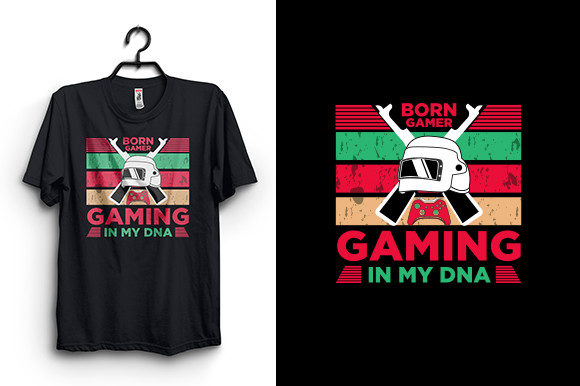
Let us talk about the message itself. Gaming is My DNA is a declaration of identity. It says gaming is not just something you do—it is part of who you are. That resonates with people who grew up with controllers in their hands, who bond over co-op sessions, who build communities around their favorite titles. When you wear this shirt, you are inviting connection. Other gamers recognize the sentiment. It sparks conversations at conventions, in coffee shops, in line at the store.
But presentation matters. A poorly printed shirt with cracked lettering or misaligned graphics undercuts the message. It suggests you did not care enough to choose quality. On the flip side, a clean, crisp print on a comfortable, well-fitted shirt reinforces your credibility. The design itself should be versatile enough to work on different garments without losing its impact.
Because the artwork comes in 100% vector format, you maintain that versatility. You can place the design on a small left-chest placement, run it large across the back, or even use elements of it for smaller branding details like sleeve prints or tags. The vector source file lets you isolate elements and recolor them without losing quality, which is invaluable if you want to match a specific brand palette or event theme.
Avoiding the Cheap Knockoff Experience
The internet is flooded with low-effort t-shirt designs. You can spot them by their jagged edges under slight magnification, their unreadable small text, and their lack of alternative color options. They usually come as a single JPG file with a white background, which is nearly useless for professional printing. Buyers who grab these files cheaply end up spending more in the long run—either on failed prints, redesign costs, or unsellable inventory.
Choosing a premium quality design package with properly prepared production files avoids that trap entirely. You pay once, you get everything you need, and you do not waste hours fixing problems that should not exist. For entrepreneurs and small business owners, that time saving translates directly into faster product launches and fewer customer complaints about print quality.
Practical Advice for Anyone Buying or Using This Design
Before you commit to any t-shirt design purchase, verify the deliverables. Look for explicit mentions of file formats, resolution, and included variations. A listing that says "Ai CS version, EPS CS version, PNG 300 dpi, SVG" and "All Designs you Will get Compressed in one ZIP File" gives you clarity. A listing that shows a pretty picture and nothing else leaves you guessing.
Check whether the design license matches your intended use. Some designs are for personal use only. Others allow commercial use, such as printing on products you sell. If you plan to build a merchandise line around a Gaming is My DNA design, confirm that commercial use is permitted. A professional package from a reputable designer typically includes both personal and commercial usage rights, but you should always verify.
Test the files before printing in bulk. Order a single sample shirt using the supplied design files. Check the print clarity, the color accuracy, and how the garment holds up after washing. This small investment prevents large-scale mistakes that cost far more than one sample.
Making Small Customizations Without Damaging the Design
One advantage of receiving editable vector files is the freedom to make minor adjustments. Maybe you want to change the text slightly, swap a color, or combine the design with other elements for a unique look. With the AI or EPS files, you or a designer you hire can make those edits cleanly. With a flat PNG, you are stuck.
If you are a marketing professional or content creator, you can use the vector artwork to create matching assets across platforms—youtube thumbnails, stream overlays, social media banners—all sharing a consistent visual identity. That cohesion strengthens brand recognition far more effectively than mixing mismatched graphic styles from different sources.
Ultimately, Gaming is My DNA works best when the quality of the presentation matches the conviction behind the words. A bold statement printed with precision on a well-chosen garment communicates confidence. A sloppy print undermines everything. The files you start with determine which outcome you get. Choose organized, high-resolution, vector-based assets. Verify before you buy. Test before you scale. Your shirt—and your message—deserves that level of care.