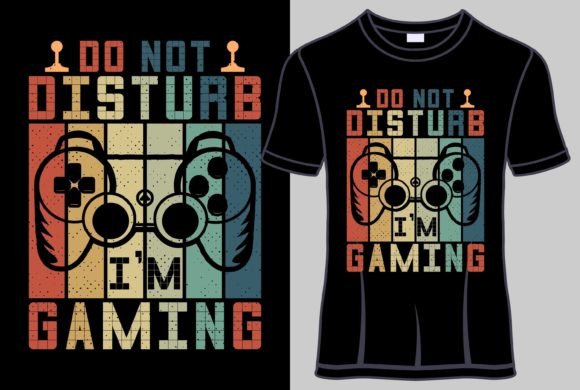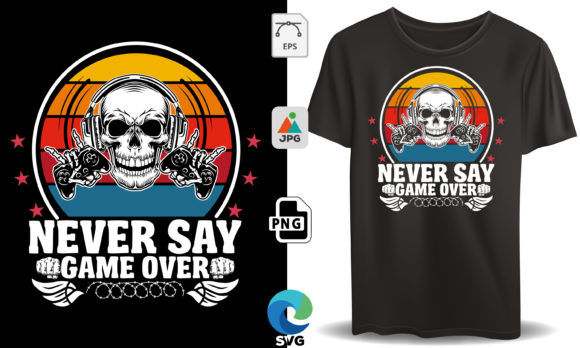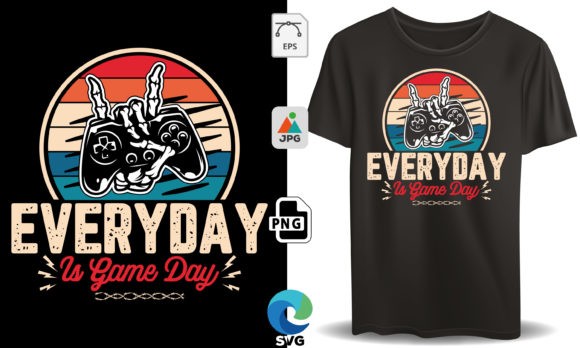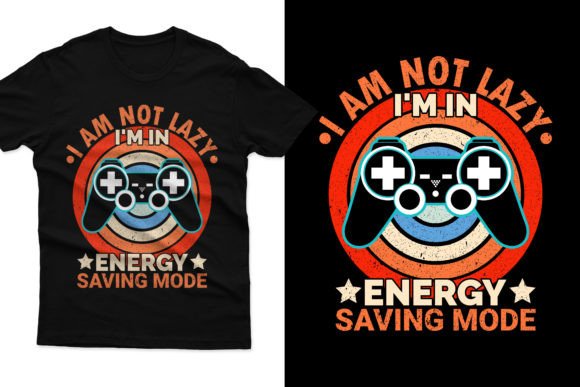
Retro Vintage Gaming T-Shirt Design
There’s something magnetic about the cracked typefaces, chunky pixel art, and neon-drenched palettes of 80s and 90s arcade screens. A Retro Vintage Gaming T-Shirt Design bottles that raw energy and lets you print it onto fabric, mugs, stickers, and just about anything else that holds ink or vinyl. For designers, brand owners, and hobbyists, it’s not just a graphic—it’s a mood piece that connects generations through shared screen memories.
Whether you’re building a small merch line, creating custom gifts for a gaming group, or spicing up a personal wardrobe with something that doesn’t feel mass-produced, a well-crafted gaming retro vintage t-shirt design becomes a flexible asset. What makes it particularly practical today is how it often arrives as a bundled digital kit that respects both creative freedom and output consistency.
What Makes a Design “Retro Vintage” in Gaming Apparel?
The term gets thrown around loosely, but there are clear visual signals that set a Retro Vintage Gaming T-Shirt Design apart from modern esports graphics. You’re usually looking at one or more of these ingredients:
- Pixel-based characters and icons rendered with deliberate blockiness, often at a scale where individual pixels become a feature, not a flaw.
- Distressed textures, halftone dots, or simulated wear that suggest a tee you’ve owned since the 90s.
- Typographic choices inspired by coin-op cabinets—heavy sans serifs, curved arches, or cracked lettering.
- Color stories built around neon cyan, magenta, deep violet, and electric green, sometimes muted for that faded arcade marquee look.
- Framing devices like scanlines, inset screens, or joystick-and-button motifs.
Those elements don’t just appeal to nostalgia; they carry a visual weight that works well on the irregular surface of a t-shirt. A smart Gaming retro vintage t-shirt design will offset busy pixel detail with generous negative space so the graphic breathes on fabric and remains readable from a distance.
The Digital Toolbox Behind the Look
What often surprises first-time buyers is that a single purchase can include several file formats, each engineered for a different stage of the creative process. A typical download bundle for a Retro Vintage Gaming T-Shirt Design might contain:
- High-resolution PNG (300 dpi) – ready for direct-to-garment printing or mockups, with a transparent background that drops seamlessly onto any colored shirt.
- SVG and EPS vectors – fully scalable outlines that let you resize the graphic without losing an ounce of crispness, ideal for screen printing or oversized wall graphics.
- AI source file – an editable Adobe Illustrator document where every shape is accessible, making color changes, layer reordering, and customization straightforward.
- JPG copy – a flattened preview or print companion that works for quick placements and online previews.
Having this mix isn’t just convenient; it’s a form of future-proofing. Need the design on a hoodie pocket? The SVG scales down with perfect fidelity. Want to burn the graphic onto a wooden coaster? The EPS file talks directly to laser engraving software. Running a bulk screen print job? The vector originals won’t embarrass you with jagged edges when screens get prepared at full size.
Practical Use Cases That Go Far Beyond T-Shirts
The name says “t-shirt,” but a quality Retro Vintage Gaming T-Shirt Design is rarely confined to cotton tees. Because the source files are provided in resolution-independent formats, the same graphic naturally migrates across entire product catalogs and creative mediums. Here are a few paths that buyers regularly take:
Personal Wardrobe and Custom Apparel
For individuals, it’s the fastest route to wearing something that nobody else owns. You can take a Gaming retro vintage t-shirt design vector, tweak the colorway to match a specific pair of sneakers, and have a one-off tee printed locally. Iron-on transfers work surprisingly well for small batch experiments, and the included PNG with 300 dpi resolution means even home iron-on paper produces clean results if you follow proper heat settings.
Mugs, Phone Cases, and Everyday Accessories
Because the design ships with a transparent PNG and vectors, sublimation printers can ingest the file directly. Picture a mug wrapped edge-to-edge in faded pixel art, or a pink phone case that features a distressed joystick emblem. The versatility here turns a single asset into a small merchandise ecosystem. Home-based crafters using Cricut or Silhouette machines particularly appreciate SVG files that come ready to cut with zero manual tracing.
Streamer Gear and Small-Brand Merch
Content creators and indie game studios often need quick-turn branding that feels authentic without months of custom illustration. A Retro Vintage Gaming T-Shirt Design can be recolored to align with channel branding, paired with a username, and dropped onto hoodies, stickers, or stream overlays. The EPS version allows professional print shops to split colors for screen printing, keeping production costs predictable even for small runs.
Scrapbooking, Posters, and Home Decor
Physical crafters lean on the PNG and JPG files for high-quality prints that slot into scrapbook layouts or frame-ready posters. Because the zip includes 100 vector shapes, you can also break apart the design—use just a pixel heart or a joystick icon as a standalone embellishment. Teachers and event planners have used these pieces for arcade-themed party decorations, printed in bulk from a home inkjet onto card stock.
Engraving and Vinyl Decals
Laser engravers and vinyl cutters thrive on clean vector lines. The AI and EPS files give exactly that, with no need to live-trace a pixelated preview. Laptop lids, hard hat stickers, car window decals—they all benefit from a graphic that was built from the start as a crisp, scalable shape rather than a photograph of a drawing.
Why the “Print Ready” and Color-Change Features Matter
Two promises in the description—100% print ready and change color possible—deserve a closer look because they directly affect how much time you’ll spend in editing software.
Print ready means the pixel-based PNG files are already set at 300 dpi with transparent backgrounds, sized appropriately for apparel without requiring resampling. You don’t need to run upscaling filters that soften edges; the graphic lands in your print canvas with the exact sharpness it was authored in. For screen printers, the vector files use flat, separated colors that translate cleanly to screens, reducing the back-and-forth with the print shop.
Change color possible signals that the vector artwork is structured with easily selectable shapes. In Adobe Illustrator or free alternatives like Inkscape, each color block is a distinct path. You can click a neon green joystick and swap it to navy blue, or recolor the entire design in minutes. This flexibility is crucial when placing the same Retro Vintage Gaming T-Shirt Design on light shirts (where dark outlines work) versus dark shirts (where a knocked-out white-ink version looks far better). Flashy neon originals are eye-catching in previews, but the real-world winner is usually the customer who can tone things down to a monochrome print without losing the vintage character.
Selecting and Evaluating a Retro Gaming Design Pack
Not every download labeled “retro gaming” will give you professional output. Before you click buy, run through a short mental checklist:
- File inventory: At minimum, you want an editable vector format (AI or EPS) and a high-res PNG. SVG is a strong bonus if you use hobby cutters.
- Vector quality: Look for products that mention “100% vector shapes” or “fully editable text”; these confirm the art was built in a vector program rather than auto-traced from a blurry JPEG.
- Resolution: 300 dpi is standard for physical print. Anything lower will show softening on fabric, especially with fine pixel details.
- Licensing flexibility: Understand whether you can use the Gaming retro vintage t-shirt design on items you sell. Many boutique artists allow physical product use but prohibit reselling the source files as-is.
- Complexity balance: A design that’s too intricate can become a muddy mess on textured canvas; one that’s too simple might lack the nostalgic punch. Look for a composition that uses breathing room around focal elements.
When you’ve narrowed down the options, open the AI or SVG file in your software of choice and click through the layers. Designs that group related shapes logically save hours if you plan to mix and match components later. You might reuse a pixelated heart from the tee for a sticker and the joystick icon for a twitch badge—layer hygiene in the source file makes that possible without frustration.
Getting the Best Output from Your Files
The end result on a physical product depends as much on your preparation as on the original art. Even a pristine Retro Vintage Gaming T-Shirt Design can look mediocre if the production steps are overlooked. A few recommendations gathered from experienced printmakers and crafters:
- Match the file to the method: Use the vector EPS for screen printing, the PNG for DTG (direct-to-garment) and sublimation, and the SVG for cutting plotters.
- Test colors on the actual substrate: A neon pink that pops on a white screen becomes faint on a navy tee. Create a quick mockup or print a small swatch before committing to a full run.
- Preserve transparency: Always place the PNG over a colored background in your design software rather than flattening prematurely. This keeps the distressed edges and halftone patterns intact.
- Scale thoughtfully in vector: When enlarging a design for a hoodie back, check that line weights and pixel gaps don’t become disproportionately chunky. Adjust stroke widths manually if needed.
- Save print settings: If a local printer asks for a specific color profile or file version, duplicate the original and prepare a print-specific copy so your editable master remains pristine.
Why the Nostalgic Appeal Endures Commercially
The continued demand for retro gaming graphics isn’t just sentimentality. It aligns with a broader aesthetic that values authenticity and analog texture in a high-definition world. A Retro Vintage Gaming T-Shirt Design serves as an identity badge for people who grew up with consoles or arcades and for a younger demographic that romanticizes that era. On a commercial level, the design opens doors to limited drops, event-specific merch, or employee uniforms at a barcade that need to feel on-theme without screaming “costume.”
No single image fits every need, which is why the ability to recolor and resize 100 vector shapes changes the proposition. You aren’t buying a static image; you’re licensing a kit of parts that can evolve across seasons, platforms, and product types. Whether you output to a Cricut, a six-station screen carousel, or a high-end DTG printer, the digital bundle enables a consistency that keeps your time investment low and your creative options wide.
When your next project calls for a Gaming retro vintage t-shirt design that combines arcade grit with modern production flexibility, the takeaway is straightforward: prioritize editable vector files, verify print-ready resolution, and treat the included color-change capability as a gateway to endless thematic variations. The graphic that looks brilliant on a white tee at noon should look just as compelling on a black hoodie at midnight, and with the right file set in hand, it will.